
 English
 中文简体
中文简体 русский
 Español
 Français
What Should You Know About Plastic Spoon Molds?
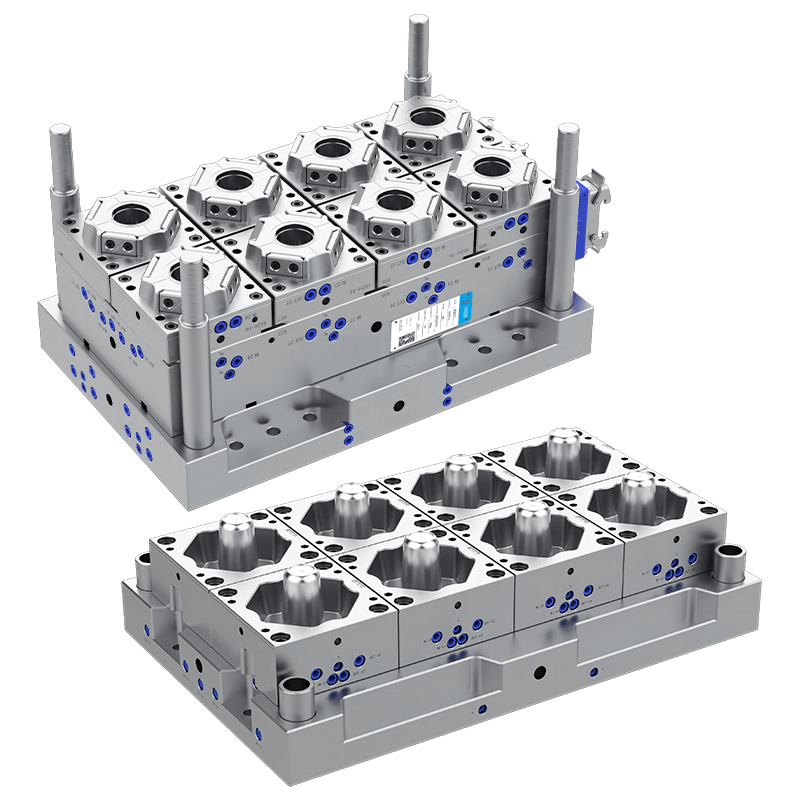
Plastic spoon molds are specialized tools used in the production of plastic spoons for food service, catering, and household use. They are an essential part of injection molding or thermoforming production lines and allow manufacturers to create spoons of consistent shape, size, and durability. The popularity of plastic spoons in fast-food services, takeout meals, and disposable cutlery sets has contributed to steady demand for these molds.
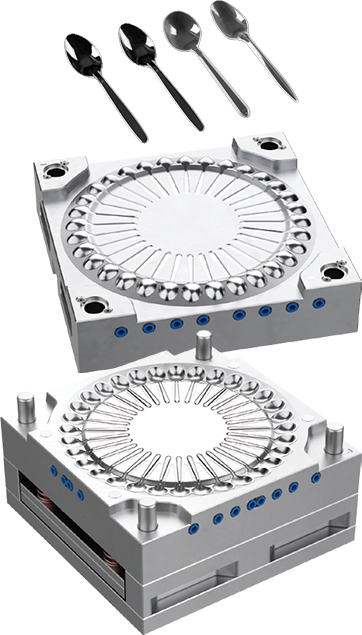
What Types of Plastic Spoon Molds Are There?
Plastic spoon molds can be classified based on the number of cavities, material output, and production method.
By Number of Cavities
Single-cavity molds
Produce one spoon per molding cycle
Suitable for small-scale production or custom spoon designs
Multi-cavity molds
Produce multiple spoons per cycle
Increase production efficiency for commercial or industrial use
Require precise alignment and uniform material flow
By Production Method
Injection molds
Use molten plastic injected into the mold cavity under high pressure
Suitable for high-volume, precise production with consistent dimensions
Thermoforming molds
Use heated plastic sheets shaped over a mold cavity
Typically used for simpler spoon designs or lower-volume production
These categories allow manufacturers to select molds that match their production capacity, material type, and product specifications. Multi-cavity injection molds are common in large-scale disposable spoon production, while single-cavity or thermoforming molds are used for specialty or reusable spoons.
Why Is Plastic Spoon Mold Worth Buying?
Investing in plastic spoon molds provides several practical benefits for manufacturers and food service businesses.
Production Efficiency
High-volume output
Multi-cavity molds allow several spoons to be produced simultaneously
Reduces cycle time per unit and lowers labor costs
Consistency
Ensures spoons have uniform size, thickness, and finish
Reduces material waste from defective spoons
Material Versatility
Compatibility with multiple plastics
Common materials include polypropylene (PP), polystyrene (PS), and polyethylene (PE)
Allows manufacturers to produce spoons suitable for cold or hot foods
Durable and food-safe
Molds designed to meet food safety standards, including FDA or EU regulations
Cost and Maintenance Advantages
Long-term investment
High-quality molds can produce thousands of spoons over their service life
Reduces recurring costs associated with purchasing pre-made spoons
Easy maintenance
Regular cleaning and lubrication preserve mold function
Repairable components allow extended usability
Versatility and Customization
Shape and design options
Molds can produce spoons with different handle lengths, bowl shapes, or decorative elements
Branding opportunities
Engraved molds can create spoons with logos or patterns for marketing or promotional purposes
These practical benefits make plastic spoon molds a valuable asset for manufacturers and service providers looking to produce consistent and cost-effective cutlery.
How Is Plastic Spoon Mold Designed?
The design of plastic spoon molds incorporates structural precision, material selection, and functional features to ensure efficient production and product quality.
Core Components
Cavities
Precisely shaped to match the spoon design
Multiple cavities allow simultaneous production of several spoons
Core and cavity plates
Provide structural stability and define the spoon's shape
Machined from high-strength steel or aluminum for durability
Material and Surface Treatment
Steel or aluminum construction
Provides resistance to wear and thermal deformation
Heat-treated surfaces maintain precision during repeated cycles
Polished surfaces
Reduce friction and facilitate smooth release of spoons
Prevent surface defects such as scratches or rough edges
Cooling and Ejection Systems
Cooling channels
Maintain consistent mold temperature to reduce warping and cycle time
Ejector pins or plates
Safely release molded spoons without deformation
Ensure smooth handling in automated production lines
Design Considerations
Tolerance and precision
High accuracy ensures spoons have uniform dimensions
Reduces material waste and production errors
Modularity
Some molds allow easy replacement of worn components
Adjustable for different spoon sizes or designs
Proper design ensures that plastic spoon molds deliver consistent quality, support high-volume production, and extend operational lifespan with minimal maintenance.
Contact Us
Email: [email protected]; Or fill out the contact form below.

Yongkang Huashun Mould Co., Ltd. is a technology-based enterprise specializing in the production of thin-walled injection molds.
PRODUCT
- Disposable Plastic Round Food Container Moulds
- Disposable Plastic Square Food Container Moulds
- Disposable Bubble Tea Plastic PP Cup Mould Series
- Disposable Plastic Knife Fork And Spoon Mould Series
- Disposable Plastic Multi-grid Food Container Mould Series
- Disposable Plastic Portion Cup Mould Series
- Disposable Plastic Cup Mould Series
 Email:
  Phone: +86-18067655796
 Tel: +86-0579-87137609
 Add: No. 218, Shangpu Road, Yongkang Economic Development Zone, Jinhua City, Zhejiang Province, China


