
 English
 中文简体
中文简体 русский
 Español
 Français
Thin Wall Food Container Mould: Design and Regional Standards
Processing Demands and Defect Prevention in Thin Wall Food Container Moulds
High-speed injection and flow length challenges.
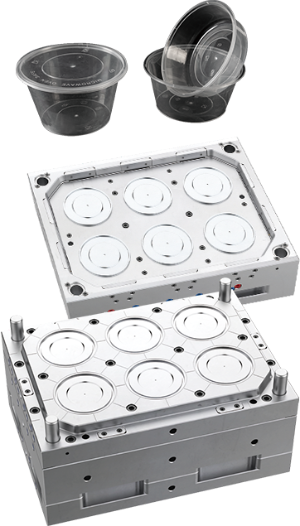
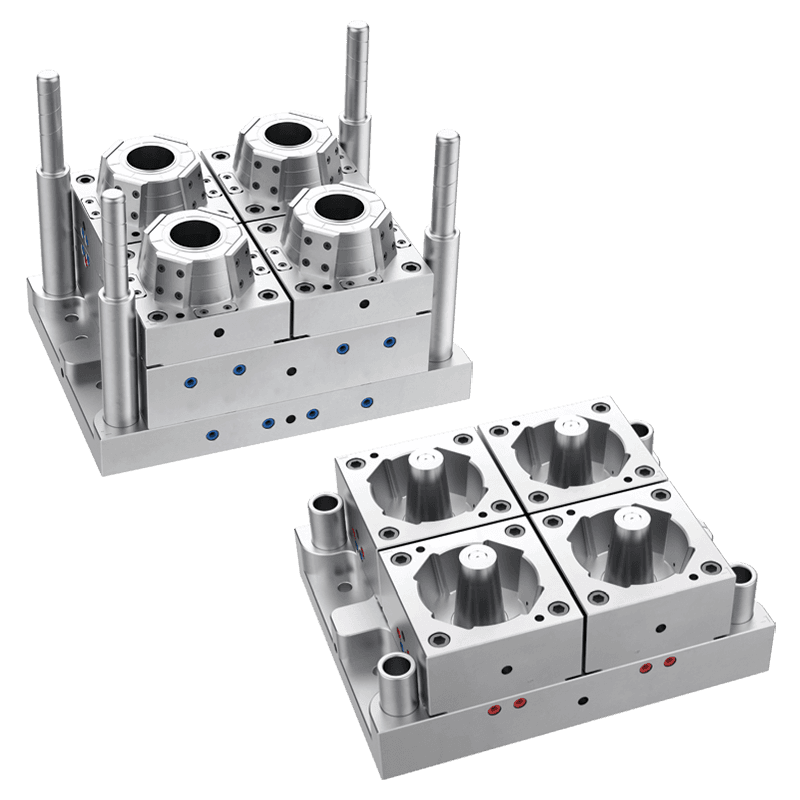
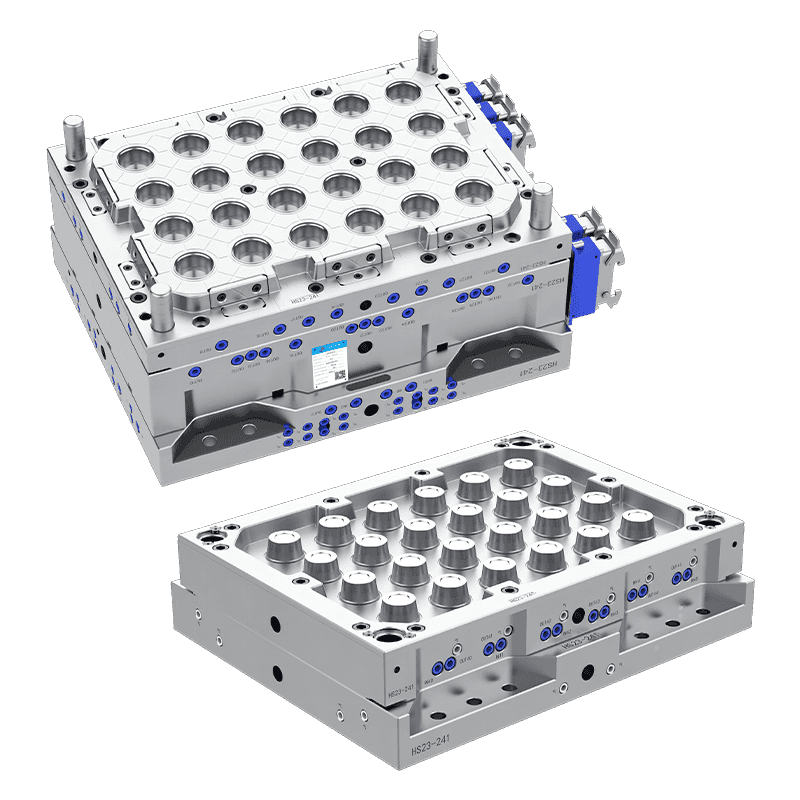
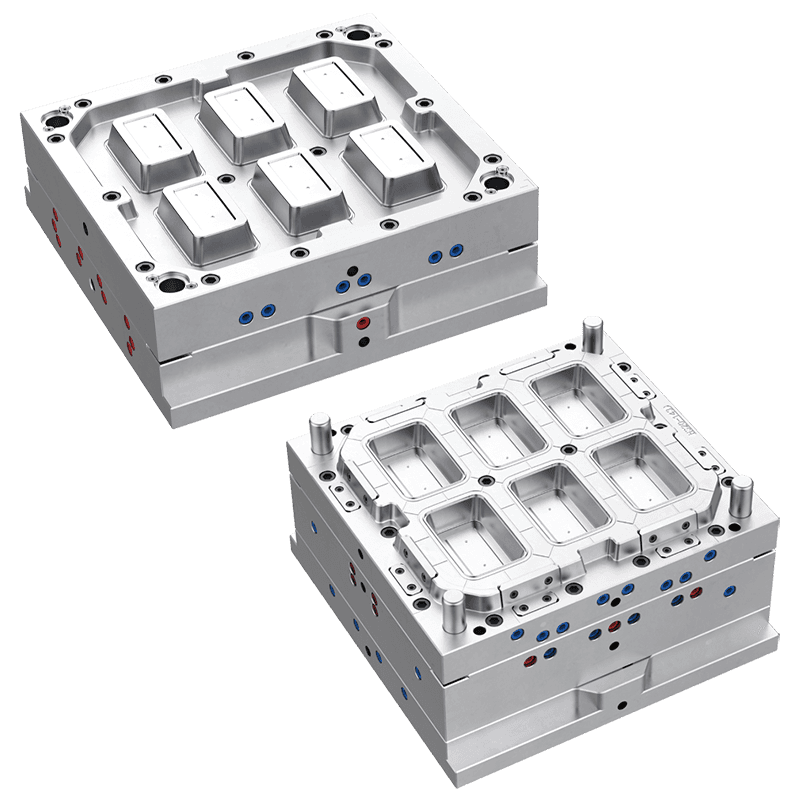
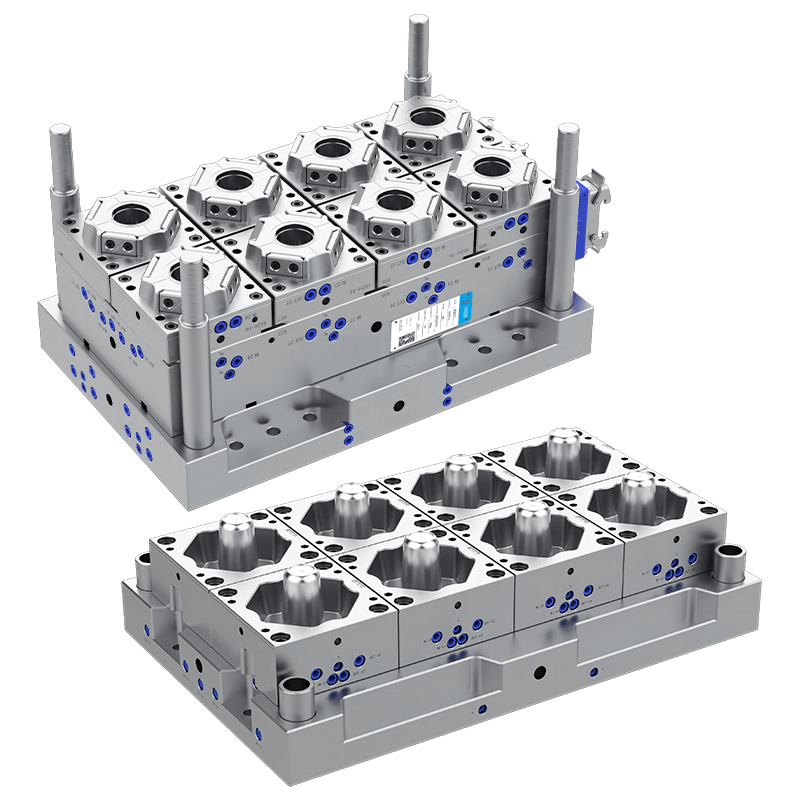
A thin wall food container mould produces containers with wall thicknesses of 0.25–0.60 mm, significantly thinner than standard containers (0.80–1.20 mm). Typical products include 200–1,000 mL containers for yogurt, margarine, ready meals, and takeout soup. The mould requires injection molding machines with high injection speeds (200–800 mm/s) and high injection pressures (150–250 MPa) because the molten plastic must fill the thin cavity before solidifying. For a 500 mL round container with 0.40 mm wall thickness, the flow length from gate to farthest corner is 150–200 mm, giving a flow length-to-thickness ratio of 375–500:Polypropylene (PP) with melt flow index (MFI) of 30–60 g/10 min is the primary material. Cavity counts for thin wall moulds range from 2 to 48; higher cavity counts require larger machines (clamping force 250–1,000 tonnes). A 48-cavity mould for a 300 mL PP container (projected area 1,800 cm²) requires 900–1,200 tonnes clamping force (calculated at 0.5–0.7 tonnes/cm²).
Gate design and melt flow balancing.
The gate—where molten plastic enters the cavity—must be sized to allow rapid filling without creating excessive shear stress. For thin wall containers, fan gates (5–15 mm width, tapering to 0.3–0.6 mm thickness) or multiple pin gates (2–4 gates per cavity) are common. A single gate at the container center (base) produces radial flow, which works for round containers up to 120 mm diameter. For rectangular or other shapes, multiple gates reduce flow distance. For a 200 × 150 mm rectangular container with two gates on the long side, fill time is 0.2–0.5 seconds. The gate must also shear cleanly; tunnel gates (submarine gates) are preferred because the gate severs as the mould opens, eliminating a separate trimming step. Tunnel gate diameter for thin wall PP is 0.8–1.5 mm, with a 30–45 degree angle. If the gate is smaller than 0.8 mm, injection pressure increases by 30–50%, risking short shots; if larger than 1.5 mm, the gate vestige (remaining mark) exceeds 0.5 mm height, which may interfere with lid sealing or stacking.
Venting and air evacuation strategies.
Air trapped in a thin cavity has little space to escape; if not removed, it compresses and heats to 200–300°C, causing burn marks (brown or black spots, 1–3 mm diameter) on the container surface. Vent depth is critical: for PP, 0.02–0.03 mm; for PET, 0.01–0.02 mm. Vents wider than 0.04 mm allow flash (plastic leakage), ruining the container edge. For a 32-cavity mould producing 500 mL round containers, total vent length (the combined length of vent channels at the cavity perimeter) is 400–600 mm per cavity, or 12–19 meters across all cavities. During the 0.2–0.5 second fill, this vent area must allow air flow of 0.5–2.0 L per shot to escape. Some thin wall moulds incorporate vacuum assist—a vacuum pump applied to the vent channels to draw air out before injection. Vacuum of 40–80 kPa reduces required injection pressure by 10–20% and improves fill consistency. Vacuum-assisted moulds show short shot rates below 0.1%, compared to 0.5–2.0% for non-vacuum systems. However, vacuum systems require sealing the mould parting line with gaskets, adding maintenance complexity.
Cooling system for rapid solidification.
Thin wall containers solidify quickly because the wall is thin—0.40 mm PP cools from melt temperature (220–240°C) to ejection temperature (80–100°C) in 2–5 seconds. The mould must remove this heat uniformly to prevent warpage. Cooling channels are placed 6–12 mm from the cavity surface, with coolant (water at 8–20°C) flowing at 10–20 L/min per circuit. Conformal cooling (channels following the container contour) reduces cooling time by 15–30% compared to straight-drilled channels. For a rectangular container with conformal cooling, temperature variation across the cavity is 3–8°C; with straight channels, variation is 12–20°C. Cooling time—the longest part of the cycle—ranges from 3 to 10 seconds for thin wall containers. A reduction of 1 second in cooling time increases output by 10–15% for a 10-second cycle. Moulds that maintain consistent cooling throughout a production shift (coolant temperature rise below 2°C) achieve the shortest cycle times without defects.
Contact Us
Email: [email protected]; Or fill out the contact form below.

Yongkang Huashun Mould Co., Ltd. is a technology-based enterprise specializing in the production of thin-walled injection molds.
PRODUCT
- Disposable Plastic Round Food Container Moulds
- Disposable Plastic Square Food Container Moulds
- Disposable Bubble Tea Plastic PP Cup Mould Series
- Disposable Plastic Knife Fork And Spoon Mould Series
- Disposable Plastic Multi-grid Food Container Mould Series
- Disposable Plastic Portion Cup Mould Series
- Disposable Plastic Cup Mould Series
 Email:
  Phone: +86-18067655796
 Tel: +86-0579-87137609
 Add: No. 218, Shangpu Road, Yongkang Economic Development Zone, Jinhua City, Zhejiang Province, China


