
 English
 中文简体
中文简体 русский
 Español
 Français
Rectangular Food Container Mold: Efficient Tool for Space-Saving Packaging
The rectangular food container mold has become a preferred manufacturing solution for packaging producers serving the food service, retail, and meal-prep industries. This mold is engineered to produce rectangular containers that improve storage efficiency and shelf space utilization, with capacities typically ranging from 8 to 64 ounces. Recent packaging industry data indicates that rectangular container molds have gained significant market share due to their space-saving design, efficient shipping characteristics, and versatility for a wide range of food products including prepared meals, deli items, and takeaway entrees. The mold's design prioritizes consistent wall thickness, reliable sealing performance, and high-output production capability.
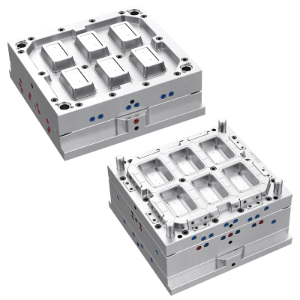
Cavity Configuration and Rectangular Geometry Design
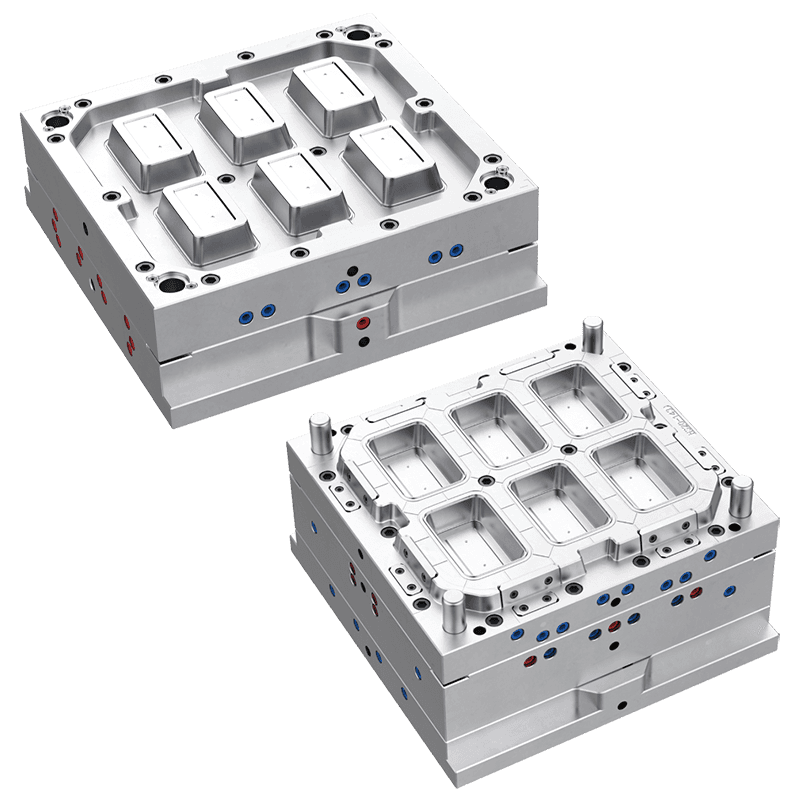
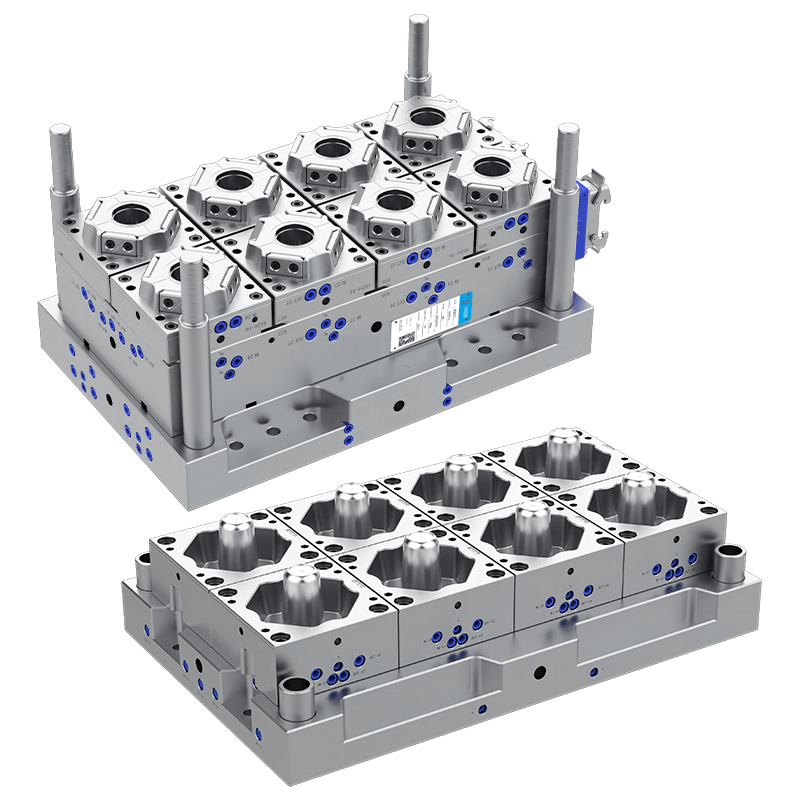
The rectangular food container mold is designed with precision-machined cavities that produce containers with consistent wall thickness and dimensional stability across all corners and edges. The cavity geometry includes slightly rounded corners that facilitate material flow and prevent stress concentration, while maintaining the rectangular shape that optimizes storage efficiency. The mold design incorporates a flat bottom for stability and even heating, straight sidewalls with a slight draft angle for easy part ejection, and a reinforced rim that provides structural strength and a secure sealing surface for the lid. The rectangular geometry requires careful consideration of gate placement to ensure balanced filling, with the gate typically positioned at one end or along the sidewall to less flow marks and weld lines. The cavity surface is polished or textured to achieve the desired finish.
Lid Design and Sealing System Integration
The rectangular food container mold is often designed to produce both the container body and its matching lid, either as a single mold with interchangeable cavities or as separate molds for dedicated production lines. The lid cavity is designed with a sealing rim that engages with the container's rim, creating a secure closure that prevents leaks and maintains food freshness. The lid design includes features such as a raised tab for easy opening, recessed panels for stacking stability, and ribbing for structural strength that prevents warpage. The sealing system is designed to provide consistent performance across the full range of operating temperatures. The lid and container are designed to nest together securely for efficient storage and transport.
Cooling System and Production Efficiency
The rectangular food container mold incorporates high-efficiency cooling systems that are critical for achieving fast cycle times and consistent part quality. The cooling channels are strategically positioned to provide uniform heat transfer across the entire cavity surface, preventing warpage and ensuring dimensional stability. The cooling system includes conformal cooling channels that follow the container's rectangular contour for uniform cooling, and high-flow circuits that ensure rapid heat removal. The cooling system is designed to less cycle times while maintaining part quality. The efficient cooling system enables cycle times as low as 4 to 8 seconds, allowing manufacturers to achieve high production rates.
Material Selection and Application Versatility
The rectangular food container mold is designed for use with a range of materials commonly used in food packaging. Polypropylene offers heat resistance, clarity, and microwaveability for hot-fill and reheating applications. Polyethylene provides flexibility, impact resistance, and moisture barrier properties for cold storage. The mold design must account for the material's flow characteristics and shrinkage behavior to ensure consistent part quality. Key material considerations include:
- Heat resistance for hot-fill and microwave applications;
- Impact resistance for stacking and transport durability;
- Clarity for product visibility and consumer appeal;
- Shrinkage control for dimensional accuracy and lid fit.
The material selection also considers the container's intended use, with polypropylene preferred for microwaveable meals and polyethylene for冷冻 storage and deli applications.
Production Quality and Industry Applications
The rectangular food container mold undergoes rigorous quality assurance procedures to ensure consistent part quality and long service life. The mold is tested on an injection molding machine to verify cycle time and part quality, with parts inspected for dimensional accuracy, wall thickness consistency, and sealing performance. The mold's components are manufactured to precise tolerances, with regular maintenance ensuring continued performance over millions of cycles. The mold's design allows for easy maintenance and component replacement.
The rectangular food container mold serves a wide range of food packaging applications across multiple sectors. In meal-prep and catering, the containers are used for portion-controlled meals, side dishes, and entrees. In retail deli and grocery, they are used for prepared salads, pasta dishes, and rotisserie items. In food service and takeaway, they are used for hot and cold entrees, soups, and desserts. The mold's design is adaptable for different applications, with cavity configurations available for various container sizes and lid styles. Proper mold selection ensures efficient production of high-quality rectangular containers that meet food safety standards and consumer expectations.
Contact Us
Email: [email protected]; Or fill out the contact form below.

Yongkang Huashun Mould Co., Ltd. is a technology-based enterprise specializing in the production of thin-walled injection molds.
PRODUCT
- Disposable Plastic Round Food Container Moulds
- Disposable Plastic Square Food Container Moulds
- Disposable Bubble Tea Plastic PP Cup Mould Series
- Disposable Plastic Knife Fork And Spoon Mould Series
- Disposable Plastic Multi-grid Food Container Mould Series
- Disposable Plastic Portion Cup Mould Series
- Disposable Plastic Cup Mould Series
 Email:
  Phone: +86-18067655796
 Tel: +86-0579-87137609
 Add: No. 218, Shangpu Road, Yongkang Economic Development Zone, Jinhua City, Zhejiang Province, China


