
 English
 中文简体
 русский
 Español
 Français

Plastic Split-type Sauce Cup Mold: Where a Thin Sauce Finds Its Way Out
A plastic split-type sauce cup mold is usually approved on a dry sample that closes neatly and looks clean. The problems start later, when the cup is filled with a thin sauce, tipped in a delivery bag, and squeezed by a customer. Leaks rarely come from the middle of the sealing edge. They come from the corners, from the hinge area, and from the gate mark that nobody thought about during design review. The mold's job is to close off those paths before the first steel is cut.
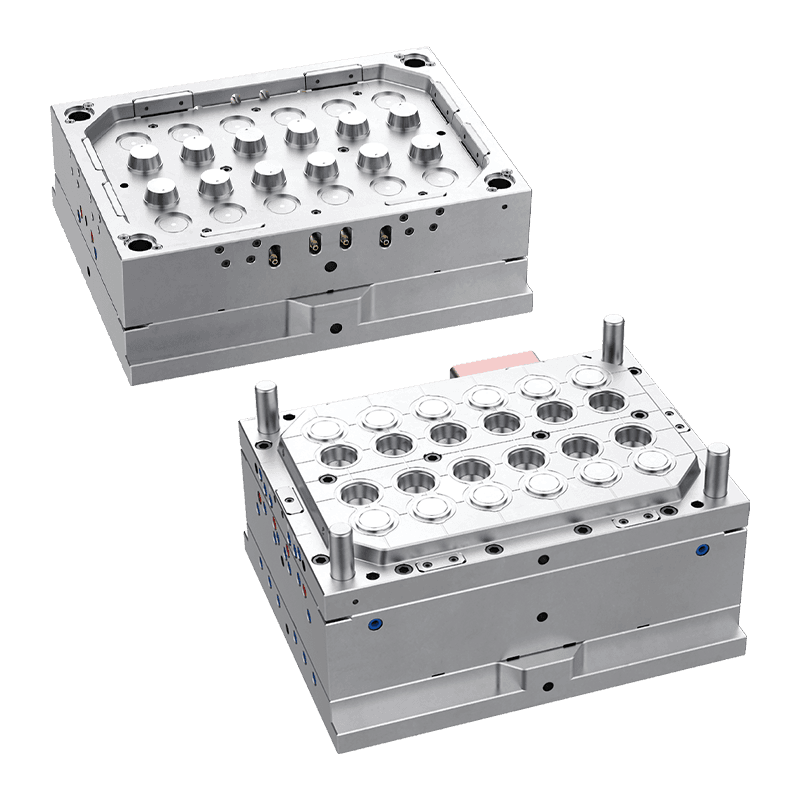
Does the hinge survive fifty openings, or only the first?
Living hinges are often judged by how they feel on a sample, which tells very little. What matters is whether the hinge keeps its shape after repeated flexing, and whether the mold can hold the hinge thickness tightly enough across cavities. A hinge that varies in thickness from cavity to cavity will fail in some cups and not others, which is worse than a consistent weakness because it hides the problem. Buyers should ask for cycle test data from several cavities, not one.
A thick hinge is not a strong hinge
It is tempting to solve hinge cracking by adding material, but a thick living hinge bends with more resistance and cracks sooner. The better question is whether the hinge geometry spreads strain along its length rather than concentrating it at one line. Mold makers who understand this will talk about hinge profile and material orientation; those who do not will talk about wall thickness alone.
The seal fails at the corner, not the edge
Most sealing edges are designed as a lip pressing into a groove, and on a straight run this works. Corners are where the geometry changes and where the lid and base are least likely to meet evenly. Two points deserve attention:
- Corner radius should match between lid and base, since a mismatch leaves a small gap that a thin sauce will find;
- The hinge side should be checked separately, because the hinge pulls the lid slightly off-center when closed.
Testing should use a thin liquid and a tipped cup, not water in an upright cup.
Cavity balance decides whether every cup seals
A sealing edge only works if the wall around it is thick enough and consistent. Uneven filling across cavities produces cups with thin sealing edges that buckle when the lid is closed. Buyers should measure wall thickness at the sealing edge from several cavities, and should ask whether mold flow analysis was used to balance the runner. A mold that fills one cavity perfectly and others adequately is a mold that will generate complaints from a fraction of every shipment.
Gate position can undo a good seal
A gate placed near the sealing edge leaves a mark, a stress concentration, and sometimes a small bump that prevents the lid from seating. Moving the gate is cheap at the design stage and expensive after the tool is cut. Buyers should confirm gate location during design review and check how the gate is finished on samples, since a sharp mark near the seal is a leak waiting to happen.
What a buyer can actually verify
Rather than comparing cavity counts, buyers can ask for cycle test data on the hinge, wall thickness measurements at the sealing edge across cavities, gate location and finishing method, and leak test results using a thin liquid. Suppliers who answer with measurements and test conditions are easier to trust than those who answer with assurances. The mold is a familiar tool; the difference lies in whether these four details were settled before the steel was cut.
Contact Us
Email: [email protected]; Or fill out the contact form below.

Yongkang Huashun Mould Co., Ltd. is a technology-based enterprise specializing in the production of thin-walled injection molds.
PRODUCT
- Disposable Plastic Round Food Container Moulds
- Disposable Plastic Square Food Container Moulds
- Disposable Bubble Tea Plastic PP Cup Mould Series
- Disposable Plastic Knife Fork And Spoon Mould Series
- Disposable Plastic Multi-grid Food Container Mould Series
- Disposable Plastic Portion Cup Mould Series
- Disposable Plastic Cup Mould Series
 Email:
 Phone: +86-18067655796
 Tel: +86-0579-87137609
 Add: No. 218, Shangpu Road, Yongkang Economic Development Zone, Jinhua City, Zhejiang Province, China


