
 English
 中文简体
 русский
 Español
 Français

Disposable Plastic PP Cup Mold: Cycle Time and Cavity Balance Decide the Economics
A disposable plastic PP cup mold is bought to make a low-cost part in very large numbers, and it is judged on whether the tool produces cups quickly, consistently, and without scrap. Buyers comparing quotations often look at cavity count and price, while the differences that decide whether the mold pays for itself sit in how the cooling is laid out, how the cavities fill evenly, and how the cup stacks and releases without deformation.
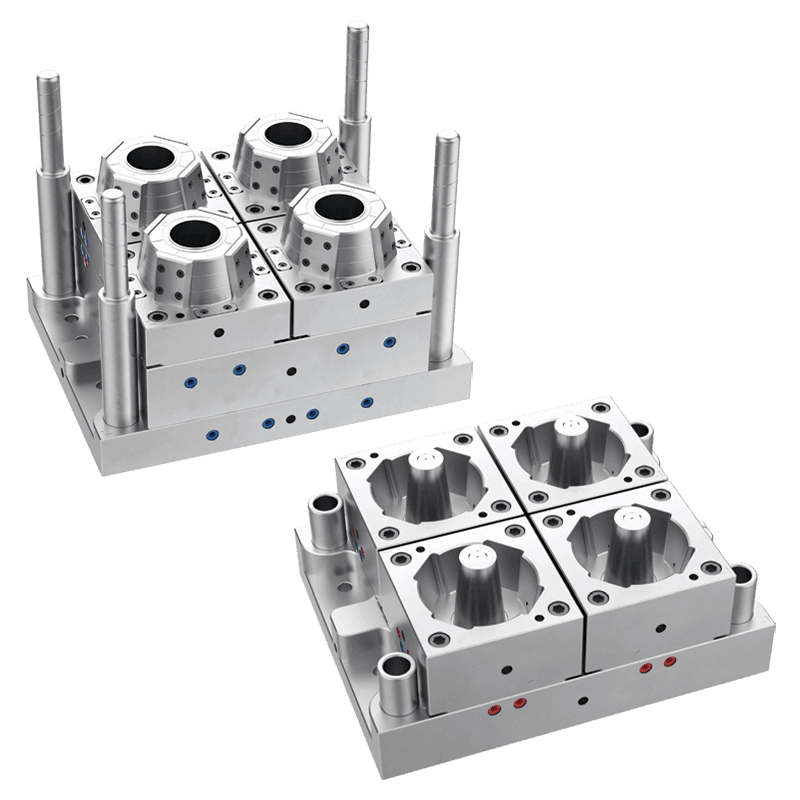
Cooling Layout Sets the Cycle Time
PP cups are thin-walled, so the plastic cools quickly, but the mold must remove heat evenly or the cup warps and sticks. Two points deserve attention:
- Cooling channels should follow the cup wall closely, since a channel that is too far from the surface extends the cycle and leaves the cup soft at ejection;
- Core cooling matters as much as cavity cooling, because heat leaves the cup through both surfaces and a hot core causes ovality and stacking problems.
Buyers should ask how the cooling circuit is laid out, whether the core uses bubblers or baffles, and how cycle time was measured. A mold with generous cooling can be dialed back, but a mold with insufficient cooling is difficult to fix later.
Cavity Balance and Wall Uniformity
A multi-cavity mold must fill every cavity at the same rate, or the cups will differ in wall thickness and weight. Buyers should ask how the runner is balanced, whether hot runner valve timing is used, and whether mold flow analysis was performed before cutting steel. Cavity-to-cavity variation shows up later as inconsistent stacking and complaints from filling lines, so it is worth measuring parts from several cavities rather than approving one sample.
Stacking and Release
A disposable cup is stacked by the sleeve, so the stacking feature has to work. A cup that nests too tightly is hard to separate, while one that nests too loosely takes more space and may topple. The mold's lip and taper geometry determine this, and buyers should test samples by stacking and unstacking sleeves repeatedly. Ejection also matters, since a thin cup can deform if ejector force is uneven. Air ejection or a stripper plate often suits thin PP cups better than pins alone.
Material, Gate Marks, and Surface
PP is a common choice for disposable cups because it is cheap, food-contact suitable, and reasonably clear or printable. Buyers should confirm the grade suits the intended use, whether the cup will be printed, and how the gate is finished. A gate that leaves a sharp mark can injure a user or interfere with stacking. Surface finish also matters for printed cups, since a rough surface affects print quality.
What to Compare Between Suppliers
Rather than comparing cavity counts and prices, buyers can ask how cooling is laid out, how cavities are balanced, how stacking was designed, and how the gate is finished. Suppliers that answer with simulation data and measured samples are easier to trust than those that answer with capacity figures. The mold is a familiar tool; the difference between suppliers lies in how carefully cooling and cavity balance are handled for high-volume production.
Contact Us
Email: [email protected]; Or fill out the contact form below.

Yongkang Huashun Mould Co., Ltd. is a technology-based enterprise specializing in the production of thin-walled injection molds.
PRODUCT
- Disposable Plastic Round Food Container Moulds
- Disposable Plastic Square Food Container Moulds
- Disposable Bubble Tea Plastic PP Cup Mould Series
- Disposable Plastic Knife Fork And Spoon Mould Series
- Disposable Plastic Multi-grid Food Container Mould Series
- Disposable Plastic Portion Cup Mould Series
- Disposable Plastic Cup Mould Series
 Email:
 Phone: +86-18067655796
 Tel: +86-0579-87137609
 Add: No. 218, Shangpu Road, Yongkang Economic Development Zone, Jinhua City, Zhejiang Province, China


